3 Forms of Public Transport in Barbados Explained
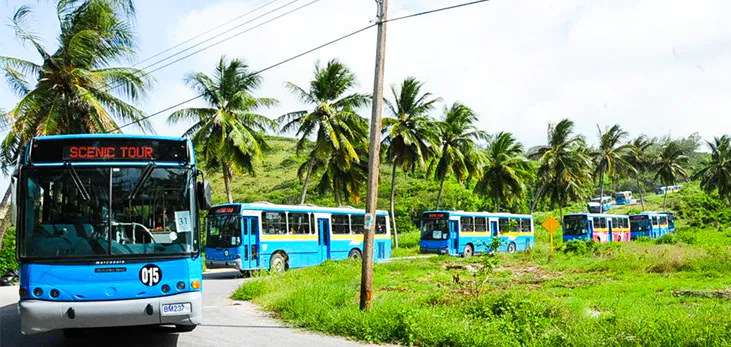

The three forms of public transport in Barbados – their advantages and disadvantages – matter more than many visitors expect. Barbados is compact, but a short distance on the map can mean a winding coastal road, a hill through cane country, or a wait outside the busiest resort areas. The good news is that getting around can be an adventure in itself, especially when you know which ride suits your plans.
Public transportation here is colorful, sociable, and unmistakably Bajan. You will see government buses, privately operated minibuses, and route taxis known locally as ZRs. Each follows established routes, each has its own character, and each can be a great option when your schedule is flexible. For a timed cruise departure, a remote trailhead, or a full day of island discovery, the trade-offs deserve a little thought.
The Three Forms of Public Transport in Barbados
1. Government buses
Government buses are the blue buses with yellow stripes, operated on routes across much of the island. They are often the easiest service for first-time visitors to identify, and their routes connect Bridgetown with major towns, residential districts, beaches, and several visitor areas.
Their biggest advantage is value. Fares are generally inexpensive and standardized, making a government bus a sensible choice for travelers who want to spend a relaxed afternoon at a beach or make a simple trip from one populated area to another. They also offer a useful slice of everyday Barbados. You may find schoolchildren heading home, commuters catching up, and fellow travelers asking the driver where to get off. A cheerful hello goes a long way.
The disadvantage is that schedules and frequency can feel less predictable than visitors from large cities may be used to. Buses can be busy at peak times, and service becomes thinner in rural areas, particularly later in the day and on Sundays or public holidays. You may not find direct routes to places that make the island memorable, such as the rugged viewpoints around Hackleton’s Cliff, the quieter lanes near the Gothic style parish churches, or the wilder east-coast scenery beyond Bathsheba.
Government buses are best for unhurried, budget-conscious travel along well-used corridors. Carry small cash, ask politely if you are uncertain about the stop, and allow more time than your map suggests.
2. Privately owned minibuses
Minibuses are usually easy to spot by their yellow exterior and blue stripe. They serve many of the same main roads as government buses, especially around Bridgetown and the south and west coasts, but they bring a livelier pace to the journey.
Their advantage is speed and availability on popular routes. When one comes along with room to spare, it may get you moving faster than waiting for a larger bus. The atmosphere can be part of the fun, too. Music may be playing, conversation may be flowing, and the ride often feels like an invitation into the rhythm of local life. For visitors staying near the coast and traveling short distances during the day, minibuses can be convenient and entertaining.
That personality also comes with trade-offs. The ride can be more energetic than some passengers prefer, and stopping patterns can feel informal to newcomers. A minibus may be crowded, particularly at busy times, and it is not the ideal choice if you are carrying beach gear, shopping bags, or luggage. Travelers with young children, limited mobility, or a firm dinner reservation may find the uncertainty stressful rather than charming.
Treat a minibus as a practical local ride, not a private sightseeing service. Let the driver or conductor know your destination when you board, keep your belongings close, and hold on when standing. Barbados has left-side driving, so give yourself a moment to get oriented before stepping out into traffic.
3. Route taxis, or ZRs
Route taxis, widely called ZRs, are small white vans marked with a maroon stripe. The name comes from their license plate prefix, and locals often pronounce it “zed-ars.” Like minibuses, ZRs run set routes and pick up passengers along the way. They are a familiar sight in and around Bridgetown and on other busy routes.
The main advantage of a ZR is flexibility. They tend to make frequent stops and can be useful for short hops where a full-sized bus feels unnecessary. They are also a distinctly local Barbados experience. If you are comfortable with spontaneous travel and enjoy observing the island beyond hotel gates, a ZR can turn an ordinary transfer into a lively story for later.
The disadvantages are similar to those of minibuses, with a little less personal space. ZRs can fill quickly, and they are not designed for oversized luggage, bicycles, or a large family group trying to stay together. They also do not operate like on-demand taxis, despite the name. You cannot hire one exclusively or expect it to detour for a hidden beach, a country trail, or a scenic stop because the view has suddenly demanded a photograph.
A ZR works well for travelers making a short, daytime trip along a known route. It works less well when your itinerary depends on exact timing, comfort, or access to places beyond the main transport network.
How to Choose the Right Ride for Your Day
The best choice depends on what you want from the day. If you are heading from Bridgetown to a beach, browsing a market, or exploring a nearby neighborhood without a tight schedule, public transportation is affordable, friendly, and full of character. Government buses offer a calmer experience, while minibuses and ZRs tend to be quicker and more animated.
If you are traveling as a couple with only a small day bag, the system is easier to use. If you are moving a family, carrying luggage, or traveling with a stroller, the calculation changes. A rental car or prearranged transportation may be more comfortable, though driving on unfamiliar roads and finding parking can introduce their own headaches.
Timing is the other deciding factor. Public transport is not the best fit when you need to be back at a cruise terminal by a specific hour, arrive at an airport, or meet a guide at a remote starting point. Barbados is laid-back, but a ship’s departure time certainly is not. Leave a healthy buffer, especially when changing vehicles or traveling from the east or north of the island.
Where Public Transport Can and Cannot Take You
A public bus can reveal plenty of real Barbados: village shops, cricket grounds, churches, school runs, and roadside food stalls. For travelers who enjoy going slowly, that is part of the reward. It can also reach several beach and town areas without the expense of private transportation.
But many of the island’s most rewarding landscapes sit beyond the simplest routes. A bus will not easily connect the coastal tracks near Edge Cliff, the agricultural landscapes around PEG Farm, or secluded countryside lanes where green monkeys flash through the trees and the Atlantic wind does the talking. Reaching those places often involves multiple connections, a long walk along narrow roads, or a plan that becomes more complicated than a vacation day needs to be.
That is where a small guided experience makes a meaningful difference. eBike Barbados includes island-wide pickup and drop-off, so guests can spend their time riding, hiking, spotting birds, and hearing the stories behind the landscape rather than decoding transfers. Pedal-assist bikes also make the island’s rolling terrain welcoming for mixed-ability groups, while a local guide handles the route, safety, and the good bits you would otherwise pass without noticing.
Practical Tips for Riding Like a Visitor Who Knows Better
Keep cash in small denominations, since public vehicles generally do not operate like app-based rides with card payments. Confirm your destination before boarding, particularly if you are unsure whether a vehicle travels the full route. Drivers and conductors are used to questions, and a friendly “Does this go to…?” is perfectly normal.
Dress for the heat, but bring water and sun protection. Vehicles can be warm, and a quick trip has a way of becoming a longer one when there is a good lime, a market stop, or a missed connection. Avoid carrying valuables loosely, especially in a crowded van, and do not assume a late-afternoon service will be as frequent as the one you used at midday.
Most of all, leave room for the human side of the journey. Public transport in Barbados is not always polished, punctual, or quiet. It is often funny, generous, and real. Use it when the day allows for a little flexibility, then choose organized transportation when your time, comfort, or destination calls for it. That balance leaves you free to enjoy the island rather than spend the afternoon wondering when the next bus might appear.